At last I have read this book. The title is so well known but I’d never read it before. It’s not a big book, and, unusual for me, I’d finished it in a couple of days or so. I’m glad I read it – It’s an excellent book.
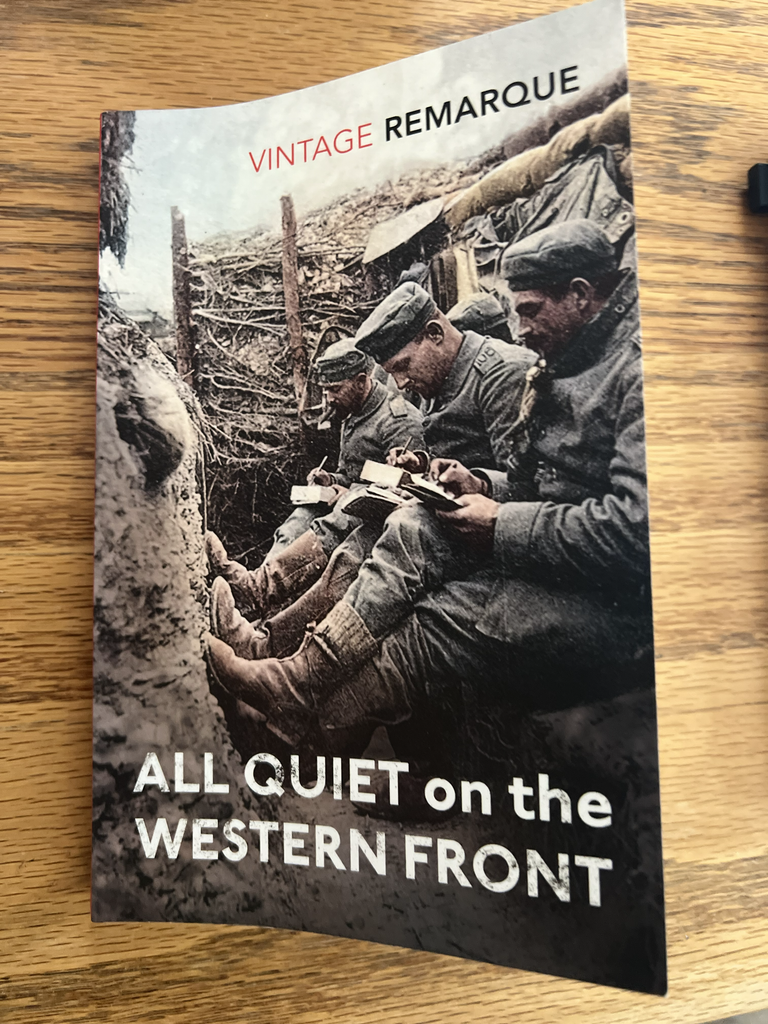
The war stories that we Brits hear are usually written by, and are about, people on ‘our side’. But this book is a German book, telling the story of a group of teenagers – friends from school – posted to the front in the first world war. But it’s not pro-Germany, or indeed pro-any side. It’s just an honest, straight-forward, well-written story of what it was like fighting at the front. If it is pro or anti anything, then it is anti-war. The Nazis didn’t like it – the book was publicly burned by them and its author, Eric Maria Remarque, had to leave Germany and settled in America. His sister was executed by the Nazis.
It’s a beautifully readable style of writing. I read it with a strong feeling of empathy with the author and with the characters in the book. Although it’s fictional, it’s written from Remarque’s personal wartime experience.
He describes what most of us will never know – the down-to-earth daily happenings of life at the front:-
New recruits – teenagers fresh from school, learning ‘on the job’ – they don’t even know how to take cover when they first arrive; the old hands who are expert at ‘making do’ – finding food – catching and cooking a goose and even making a white sauce to accompany; making a grater out of a tin lid with a few nail holes knocked through and using it to make a potato pancake.
Finding ways to get back at those who overplay the authority that a uniform and some stripes gives them; amusing role-reversal when the unpopular schoolteacher joins the home-guard and finds himself reporting to the school janitor.
The matter-of-fact descriptions of the horrors of life and death on the front line, and the hopeless inability to revert to a ‘normal’ home life after these experiences.
How close the hardships make the friendships grow; the bartering that becomes second-nature to all – how to exchange something you have for something you need; using some of your tobacco allowance to persuade the medical orderly to put you next to your mate on the hospital train; desperately not wanting to be alone.
The conversations between the friends to divert their thoughts; the idea they talk about to settle future conflicts:- if two countries want to go to war, the two leaders of the countries, or the major generals for example, should get together in a ring, fight it out, and whoever wins, wins for their country. And that’s it – done. That, the friends conclude, would be a much more efficient and far less destructive way of deciding the outcome of war.