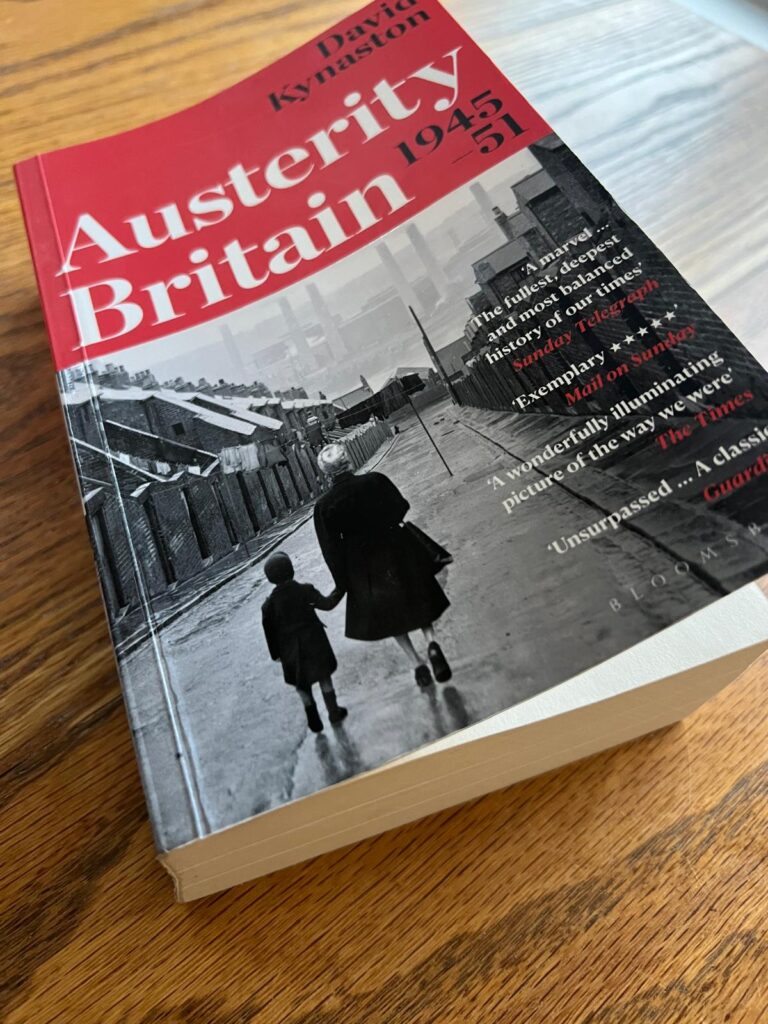
Margaret bought me a book entitled ‘Austerity Britain’. No, it’s not about Rachel Reeves’ Britain – although there are depressing similarities – it’s about Britain immediately after the war – 1945 to 1951 – when Margaret and I were small kids. It’s a hefty book and includes lots of excerpts from peoples’ diaries, interviews, and surveys, building a picture of what life was really like during that period.
I wanted to try to retain at least some of this picture in my head, so here, in four or five pages, is my cut-down version of the 600+ pages in the book! No pictures I’m afraid – just words.
It’s the 8th May 1945. It’s over a week since Hitler’s death and Winston Churchill is broadcasting to the nation from Downing Street. “The evil-doers now lie prostrate before us” he says, as he announces that the war (at least in Europe) will officially end shortly after midnight.
Huge crowds are gathering in city centres to celebrate. In central London a bus manages to get through the crowds in Whitehall. “HITLER MISSED THIS BUS” is chalked across it.
Britain in 1945:- No supermarkets, no motorways, no tea bags, no microwaves, no dishwashers, no CD’s, no computers, no mobiles, no duvets, no Pill, no trainers, no huddies, no Starbucks.
Shops on every corner, pubs on every corner, cinemas in every High Street, red telephone boxes, Lyons Corner Houses, trams, trolley-buses, steam trains, Woodbines, Senior Service, smoke, smog.
No launderettes, no automatic washing machines. Abortion illegal, homosexual relationships illegal, capital punishment legal. White faces everywhere. No high rises, no seat belts. Meat rationed, butter rationed, lard rationed, margarine rationed, jam rationed, eggs rationed, sweets rationed, soap rationed, clothes rationed. Make do and mend.
Life was tough for the men who had done most of the fighting when they returned home. Strains on marriage were severe. A couple might not have seen each other for several years; he expected to return to his familiar position as the undisputed head; she had become more independent (often working in a factory as well as running the home) – the possibilities for tension and strife were endless. Inevitably the number of divorces rose sharply – from ~ 7,000 in 1939 and over 12,000 in 1944 to over 60,000 by 1947. Even where the marriage held together (as the great majority did) the experience for children could be deeply bewildering and even damaging. “I did not like this tall, weird, cold man”, one girl remembered about the return of her POW father: “After such a close relationship with my lovely warm, kindly grandad and Uncle Colin. Of course, I did not understand at the time – but it became clearer as I became older – that Dad had become quite mentally unbalanced by his incarceration.”
Shortly after the end of the war there’s an election that Churchill, the Conservative and popular wartime leader, is generally expected to win. Surprisingly though labour win and Clement Atlee becomes the new prime minister.
Two days after the election Atlee is in Potsdam meeting with Stalin. Stalin doesn’t have to worry about elections and wants to know about Churchill’s inexplicable defeat. Atlee tells him: “One should distinguish between Mr Churchill the leader of the nation in war, and Mr Churchill, leader of the conservative party”.
Lord Beaverbrook put it like this: “The unpopularity of the conservative party proved too strong for the greatness of Churchill and the affection in which he is held by the people.”
Britain had been a nation vastly divided by class. What your father did, how you spoke, and whether your family could afford to educate you and keep you in good health set you on your path for life. But the war was a great disrupter – although that word hadn’t been invented at that time. The nation going to war meant that it’s people had to mix more, had to travel more, and experience how the other half lived more. The nation came out of the war with a determination that society had to change.
A cable-maker described what he saw as the chief differences between a manual worker’s situation in the workplace and that of an ‘office man’: “I start at 7:30 in the morning, an ‘office-wallah’ starts at 9:00. He works in a collar and tie and has clean hands, and I have to dirty my hands. What he does can be rubbed out with a rubber, while what I do stays. He keeps in with the boss class. He has a full sick-wage, while I have none. He has a salary, while I am an hourly rated man. His holidays are twice as long as mine. He has superannuation, while I have none. He eats in the staff dining room and has a better-served meal, which he calls lunch, while we eat in the general dining room and call it dinner.”
A worker at Ford Dagenham commented: ”They were great disciplinarians. You’d go down to where the job was, and hang your clothes up, and there’d be a man standing by this rack arrangement that the clothing was put on to. And as soon as the hooter went you would all start work immediately and out of the corner of your eye you could see this rack start to sail up into the roof with all your clothing. And there it stayed until 4:30 in the afternoon….”
And from a factory engineer: “Men are treated here as part of the machinery. But the funny part of it is that they are not looked after as the machines are, and kept in good running order. No one is interested in finding out the needs and requirements of men. They are simply taken for granted.”
In Sheffield: “Our skyline was dominated by hundreds of smoking chimneys……The steelworks’ smell and smoke was everywhere pervasive. ‘There’s nothing wrong with him,’ doctors would try to reassure anxious mothers, ‘he’s just got a Sheffield cough.’”
And a portrait of the lifestyle of the British directorate went like this: “At the summit of the industrial system stood an elite predominantly blessed with the accent of the officers’ mess: men bowler-hatted or homburged, wearing suits of military cut…..gentlemen indeed, confident of manner, instantly recognised by stance and gesture. They lived in large detached houses on a couple of acres of garden in the suburbanised countryside that surrounded the great cities, within ‘exclusive’ private estates adjacent to the golf course. They drank gin and tonic; had lunch in a directors’ dining room resembling as far as possible a club in St James’s; dined in the evenings; drove a Humber, Rover, Alvis, Lagonda or perhaps a Rolls-Royce; and were married to ladies who played bridge.”
The electorate had had enough of all this, and so, despite Churchill’s popularity, labour was elected. It was a peaceful revolution, but a revolution non-the-less. Labour had revolutionary policies. Nationalisation, nationalisation, and nationalisation – of the Health Service, the railways, coal mining, ………, and the introduction of the Welfare State. The election result came as a massive shock to the established system.
Theatre critic James Agate, after hearing the ‘appalling news’ of the labour victory rang up the head waiter of one of his favourite restaurants and said, “Listen to me carefully, Paul. I am quite willing that in future you address me as “comrade” or “fellow-worker”, and chuck the food at me in the manner of Socialists to their kind. But that doesn’t start until tomorrow morning. Tonight I am bringing two friends with the intention that we may together eat our last meal as gentlemen. There will be a magnum of champagne, and the best food your restaurant can provide. You, Paul, will behave with your wonted obsequiousness. The sommelier, the table waiter, and the commis waiter will smirk and cringe in the usual way. From tomorrow you will get no more tips. Tonight you will be tipped royally.” The head waiter said, ‘Bien, m’sieu.’ That was at quarter-past six. At a quarter-past nine I arrived and was escorted by bowing menials to my table, where I found the magnum standing in its bucket and three plates each containing two small pieces of spam!
Perhaps the most revealing detail, though, was Agate’s rhetorical question: “Who would have thought a head waiter to have so much whit in him?”
The middle classes had to give up the staples of the middle class lifestyle – domestic service, ample food and clothes, consumer durables, motor cars and luxuries such as travel, entertainment and subscriptions – all were squeezed by labour shortage and rationing as well as high taxation and rising prices. “Before the war”, complained one person “we could afford to go abroad for holidays. Last year we imposed ourselves upon relatives. We used to play golf, tennis, and badminton. How can we afford them now?” Another, a grammar school master, was only marginally less downbeat: “We could give up the car but we cling to it as a last link with comfort and luxury, having surrendered so many other things including annual holidays, library subscriptions, and golf.
Things changed, but slowly, and life was still bleak. For Bill Perks (later Bill Wyman of the Rolling Stones), growing up in Penge, the atrocious weather of 1947 meant that his bricklayer father was laid off work and there was no money coming in. “There wasn’t enough food to go round, so he’d hit a couple of us and send us to bed without dinner. You’d just get hit, and kicked up the stairs – that was it. And you didn’t want to go to bed – it was freezing cold with ice on the inside of the windows and bedbugs that drove us crazy.”
Shortages of course became opportunities for the ‘spivs’ as they were known at that time, operating enthusiastically in the black market. And all levels of society were ready to use the service. Kenneth Preston – a middle-aged English teacher at Keighley Grammar School, was told that the Bishop of Bradford and an ecclesiastical colleague had been overheard discussing a 40 pound ham they had secured and which they were going to share between them. To Preston, the most conscientious of diarists, it was yet one more sign that there was something fundamentally amiss with the post-war world: “They were paying 10 shillings per pound for the ham. It is rather shocking to think of one’s bishop engaged in black market transactions.”
To a certain extent, shortages had health benefits. The higher amounts of bread, milk, and vegetables consumed by children in 1950 were closer to the healthy eating guidelines of the Nineties. A higher calcium intake had potential benefits for bone health in later life, while their vegetable consumption protected them from respiratory disease and some forms of cancer. Fresh vegetables rather than fruit juices for vitamin C, red meat rather than poultry (which was too expensive in those days) was good for iron. Starch rather than sugar as the main source of carbohydrates was more beneficial to gastro-intestinal health. The higher calorie intake (from more animal fat) was counteracted by the more physically energetic lifestyle. Overall – a shortage of money and of choice was positively beneficial for the children of austerity.
By 1950, five years after the end of the war, some silver linings could be seen: “We could hardly believe it but last week we had eggs off ration. Absolutely remarkable and unheard of what this means to us only an English housewife can understand. We’ve been fobbed off with dried eggs and egg powder and lately not even that when at last actually we could beat up two eggs and put them in a cake the first time for 10 years”
Over the channel meanwhile, fashion was decisively moving on from wartime. The longer skirt, very much ‘in’ in Paris, but opposed in Britain – “The ridiculous whim of idle people” was the trenchant view of the labour MP Bessie Braddock. The problem in Britain was simply getting hold of clothes. Most women were glad to get any clothes they could get hold of there was just not the materials for long skirts. “We cannot give way to Paris’s irresponsible introduction of the longer skirt” was the indignant view from this side of the channel.
Others were captivated by ‘The new look’ even if they couldn’t afford it. In a 2002 interview with the photographer David Bailey, brought up in a little terraced house in East Ham with an outside toilet, he was asked about his first strong visual memory. He described going to Selfridges in 1948 when his mother tried on a new look dress she couldn’t afford but tried it on anyway. “I remember her twirling round and thinking how beautiful she was and that was my first fashion picture I suppose – taken in my head”
Benefitting from the pre-war holidays-with-pay act that gave most of the workforce a mandatory paid one-week annual break, about half the population took a holiday away from home, the overwhelming majority staying within Britain. “Blackpool – The holiday Playground of the world” was the title of the premier resort’s 1947 brochure. Sid Chaplin went for a day in June. He was impressed by the number of fish and chip shops, but said the air wasn’t very bracing, especially at ten pm when it’s full of the stench of stale beer. He enjoyed himself in the Pleasure Park though, won five woodbines at the rifle stalls and a tin ash tray …. Blackpool is a paradise for pleasure.
And there was the annual ritual of the factory outing to the seaside, nicely reflected in the Max Miller joke: – the foreman asks four pregnant women at their sewing machines when their babies are expected. “Mine’s due in May” replies the first. “Hers is also due in May, and so is hers”. “What about the other girl?” asks the foreman. “Oh I don’t know about her. She wasn’t on the charabanc trip”.
For Colin Welland (‘Z-cars‘, ‘Kes’, and writer of ‘Chariots of Fire’) growing up in Lancashire, it was the opportunity for his first holiday independent of his parents. He and two mates went to Butlins holiday camp in Skegness to celebrate their new-found freedom. Later he admits being struck by his naivety at the time. “Three girls asked us back to their chalet for a drink and we said ‘No thank you, we’re not thirsty’”.
Community-wise, Britain was a very different place in the 1950’s. It was a country of small shops. One shopkeeper argued: “If all shopping was centralised even if it did clip a few points off the cost of living, it would represent a huge loss. There’s an informality about the small shop” she argued. “Tired housewives can pop in dressed in kitchen aprons, men in dungarees call in on their way home from work. One customer regularly fetches his newspaper wearing his dressing gown; another sends his dog. And always there is a welcome for the children, an intelligent interpretation of scribbled shopping lists and a touching interest in child welfare”. To clinch her point she quoted the proprietress of a village shop: “That’s the third ice today Billy. I will not sell you anymore until I hear from your Ma”.
Community policing was done ‘on the beat’. “The man on the beat is often asked to help settle some family dispute or to adjudicate in an argument. Matrimonial advice is often sought where husbands and wives are at loggerheads. One of the boys may be insolent and so the policeman is asked to speak to him. One constable said he was asked to thrash a boy for his mother but wisely declined. A woman will stop a policeman on his beat and ask him how to apply for assistance in bringing a complaint against a landlord. Does he know a club where Charlie could go at night? Is 14/6 a week a legal rent for their sort of house?
A less intimate style of policing was starting to evolve where several beats was policed by a single team of four constables and a sergeant with a police car with radio ready to be called to trouble spots. But the evidence was that the great majority of chief constables preferred to rely on the traditional system of beat working – a conception of policing that placed overriding emphasis on prevention rather than detection of crime. Crucially it assumed close, continuous, and broadly harmonious contact between the police and the policed.
Sexual equality in the1950’s still had some way to go. The BBC ordained that news bulletins on national radio would be read only by men, & only those with ‘consistent’ pronunciation – no regional accents. The official explanation was “Experience has shown that a large number of people do not like the news of momentous or serious events to be read by the female voice”.
And on the positive side, Britain at this time was still a great manufacturing country. In 1950 the British motor industry enjoyed a staggering 52% of the world motor exports in terms of overall production. The French, German, and Italian combined total only just exceeded Britain’s 476,000. Japan meanwhile produced only 2,000 cars in the entire year!
The Afterword of the book reads as follows:
It had been an extraordinarily hard six years since the end of the war – in some ways even harder than the years of the war itself. The end was at last in sight of a long, long period of more or less unremitting austerity. Few adults who had lived through the 1940’s would readily forgo the prospect of a little more ease, a little more comfort. A new world was slowly taking shape, but for most of those adults what mattered far more was the creation and maintenance of a safe, secure home life – in any home that could be found. ‘The Safe Way to Safety whenever and wherever infection threatens in your own home’ ran the reassuring message in the spring of 1951 from the makers of Dettol. ‘Such deep, safe, soapy suds!’ was the unique selling proposition of New Rinso. ‘If it’s safe in water, it’s safe in Lux’. For the children of the 1950’s, there would be – for better or worse – no escape from the tough, tender, purifying embrace of family Britain.